Bottlenecks, Bond Vigilantes & Breakthroughs
Jack James - Sep 10, 2026
Markets may look calm on the surface, but there is a lot happening underneath. This edition looks at the stories, risks and opportunities we think matter most right now.
When we last wrote at the beginning of July, the story was one of a market taking a bit of a breather after a very strong spring recovery. Some of the more speculative parts of the AI trade had started to wobble, volatility had picked up, but underneath it all the broader investment story remained largely intact.
A couple of months later, that still feels like a pretty good description of where we are. Through the summer, Canadian equities moved modestly higher, U.S. markets were essentially flat, and bonds gave back some ground as longer-term interest rates moved higher. Now September has arrived, everyone is back from holidays and, almost on cue, markets have become a little choppier.
.png)
What is interesting is how little the conversation itself has changed. Inflation is back in focus after a couple of firmer readings, with higher oil prices and continued conflict in the Middle East adding another wrinkle to the outlook. That, in turn, has brought central-bank policy back into the conversation, while the political debate around AI has become noticeably louder and renewed trade tensions between Canada and the U.S. have once again moved to the forefront.
We understand how frustrating the continued rhetoric around trade policy has been here at home and do not view tariffs as constructive. As investors, though, it is important to remember that the economy and the markets are not one and the same thing. Our focus remains on the businesses we own and the longer-term reasons we own them. The companies that comprise our portfolios have already navigated a wide range of economic and political environments, and that resilience is worth highlighting again as the backdrop continues to change. While trade policy can certainly affect these businesses along the way, it is rarely what ultimately determines their long-term value compared with the larger trends shaping their future. Just as importantly, many of the current policies are still evolving, and recent history has shown how quickly U.S. policy can change course. For that reason, giving the situation time to develop has generally been the more prudent approach, and one that has served our clients well over the years.
Despite all of this, markets have continued to absorb this familiar collection of concerns, and that resilience has increasingly been supported by the fundamentals. Quarter after quarter, corporate earnings have continued to come through stronger than expected, particularly among many of the businesses driving this investment cycle.
At some point this pace of growth will inevitably slow, but we continue to believe there is a lot of runway left in the earnings cycle being driven by AI and the investment required to support it. For all the criticism the broader AI theme has attracted, our view remains that it is one of the pre-eminent investment cycles of our generation, and likely will remain so for some time. That does not mean returns will move in a straight line. They never do. There will be periods where expectations run too far, parts of the market become overextended and volatility forces those expectations back into line. But underneath that noise, the investment spending, productivity gains and earnings growth tied to this cycle continue to provide a very meaningful engine for the market.
Taken together, that leaves us in a fairly constructive place. Earnings remain strong, the underlying investment cycle still has plenty of runway, and importantly, none of this is happening against a backdrop of broad investor euphoria. Strong markets accompanied by healthy skepticism are generally a much more comfortable setup than markets being driven by enthusiasm alone.
With that broader picture in mind, rather than revisit the same debates again this month, I thought it would be more interesting to continue the story of 2026 with three developments from the summer that may have flown under your radar. Each, in a different way, says something about the market and investment environment we find ourselves in today.
1. When the Bottleneck Becomes the Trade
On the subject of pockets of excess, every market has them from time to time, and AI has certainly been no exception. In our last update, we pointed to some of the extraordinary moves taking place in Korean semiconductor stocks as investors increasingly searched for the next shortage, or "bottleneck", in the AI buildout.
That idea has become a trade unto itself. Memory chips, electricity, data centres, networking equipment and access to computing capacity have all, at various points, been identified as the next scarce resource investors should own before everybody else figures it out.
One of the people who became most closely associated with that thinking was Leopold Aschenbrenner. He had previously worked at ChatGPT creator OpenAI on AI safety and alignment before leaving the company and later publishing a lengthy series of essays called Situational Awareness. The essays laid out his view of how quickly AI capabilities and infrastructure needs could accelerate and became enormously influential in parts of Silicon Valley. He later launched a hedge fund under the same name built largely around those ideas.
For a while, it worked spectacularly well. Then, over the summer, things reversed quickly. Many of these stocks fell sharply, in some cases 30% to 40% or more from their highs, even as the broader market remained relatively calm. Because the fund had combined concentrated positions with significant leverage, those declines were amplified, and its public-market portfolio ultimately fell 67% in July. Remarkably, even after that collapse, it was still up about 80% for the year because of how strong the earlier gains had been.
For most investors, the entire episode passed largely unnoticed. There was no market crash and no broader financial crisis. But underneath the surface, one of the frothier corners of the AI market experienced exactly the type of unwind people often worry about.
Aschenbrenner’s underlying thesis may still prove correct. AI will require enormous amounts of memory, power and computing infrastructure, but that does not mean every company tied to those bottlenecks will become the next Nvidia. Our preference is to be more methodical, focusing on durable businesses, real earnings and the risk we are taking rather than chasing every emerging theme.
2. The Return of the Bond Vigilantes
The second story is considerably less glamorous, but probably matters to more people. There is an old expression in financial markets that when the bond market speaks, investors should listen. The term "bond vigilantes" refers to the idea that governments can promise whatever they want, but if investors become uncomfortable with inflation, deficits or fiscal policy, they can demand a higher interest rate before they are willing to lend those governments money.
We have been seeing more of that lately. Long-term borrowing costs have moved higher across the United States, Europe and Japan as investors weigh stronger growth, more persistent inflation, large government borrowing requirements and a world that simply feels less predictable than it did a decade ago.
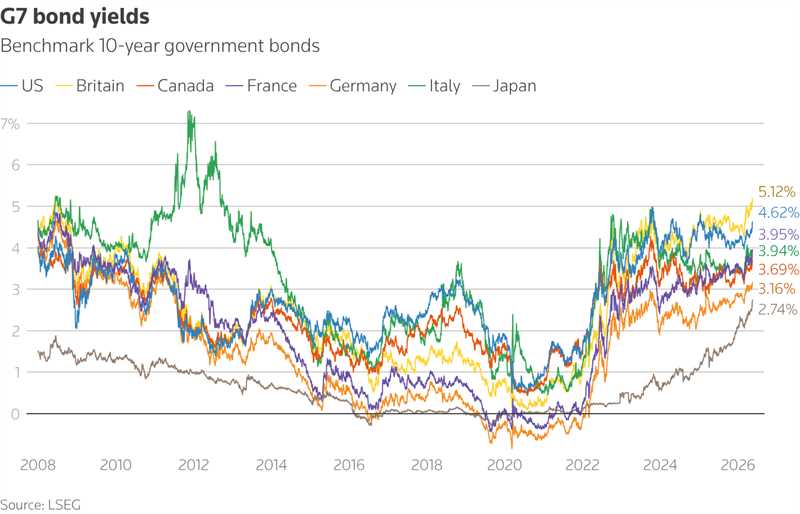
Why should anyone outside a bond desk care? Because higher borrowing costs eventually work their way through almost everything else. They influence mortgages, corporate borrowing costs, government finances and the return investors demand from stocks. All else equal, a higher cost of money is a headwind to economic growth, particularly in areas that are already sensitive to financing costs, such as housing.
There is another side to that story, however. For much of the period after 2008, investors became accustomed to governments borrowing money extraordinarily cheaply. That environment was supported by weak growth, very low inflation and central banks deliberately holding interest rates down. It is entirely possible that that was the unusual period.
If we are entering a world of somewhat stronger nominal growth, persistent inflation, huge infrastructure investment and much greater competition for capital, investors should probably expect to be paid more for lending money for 10, 20 or 30 years. Add in larger fiscal deficits and a less predictable policy environment, and that higher compensation becomes even easier to understand.
There is obviously a limit. If yields rise too quickly or too far, they can become a meaningful economic problem. But we do not think we are there yet. The areas of the economy generating the strongest growth and cash flow today are also generally much less dependent on cheap financing than businesses whose economics only worked when money cost almost nothing.
For now, we continue to view rising interest rates as something to watch rather than something to lose sleep over. We have already made some adjustments within our bond portfolios, favouring shorter-term holdings that are less sensitive to rising rates, and we will continue to adapt if the backdrop changes. As with most market risks, the key is not trying to predict every turn, but making sure the portfolio is positioned appropriately as the environment evolves.
3. AI Is Starting to Do Something Different
The final story is the one I find most interesting, because it gets closer to the reason this entire AI cycle exists in the first place. A lot of the public debate around AI has become financial or political. Are companies spending too much? Will the returns justify all these new data centres? Will AI replace jobs? Should it be more heavily regulated? Those are all reasonable questions, but they can distract from a more fundamental one: what happens if intelligence itself keeps getting dramatically better?
Over the summer, we began to see more evidence of that. Long-standing mathematical problems that had resisted researchers for years began being solved with the help of increasingly capable AI models. In some cases mathematicians were working alongside the models, while in others the models were doing much of the heavy lifting themselves. Then in early September, OpenAI released its latest model, GPT-6 Astra, which posted exceptional results on some of the hardest mathematical benchmarks used to test AI systems. Just days later, OpenAI announced that an internal system had produced a proposed solution to the Navier-Stokes problem, one of mathematics’ most famous Millennium Prize Problems:
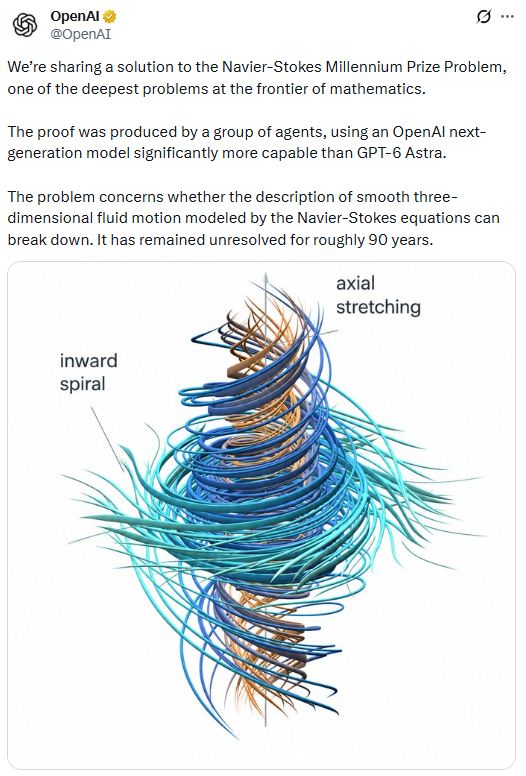
That work still needs to withstand scrutiny from the broader mathematical community, but its significance extends well beyond whether this one proof ultimately holds. It is part of a broader trend we have been watching, where AI appears to be moving beyond simply organizing existing knowledge and beginning to contribute to the creation of new knowledge. If that continues, the implications stretch far beyond office productivity. Mathematics underpins physics, engineering, materials science and medicine, so better reasoning should increasingly help accelerate progress across the hard sciences.
That gets us to the bigger question: what is all of this ultimately for? Human intelligence built the modern world around us, from medicine and engineering to computer science and infrastructure. We are still in the very early stages of understanding what happens when we pair our own intelligence with tools that can reason at a level far beyond what any one person can achieve on their own. If these systems begin materially accelerating discovery across these fields, the impact on society is likely to be profound. This is where the story becomes considerably more interesting.
- Jack
The Inheritance AI Cannot Replace

What do we really want the next generation to inherit?
In my latest article, I look beyond the traditional estate-planning conversation and ask a much bigger question. In a world where AI may make knowledge cheaper, work less necessary and wealth more capable of removing friction from everyday life, the skills that matter most may be the ones that cannot simply be handed down in a portfolio.
Resourcefulness, judgement, relationships, resilience and a sense of purpose may ultimately prove more valuable than the assets themselves. I explore why preparing the next generation is about much more than preserving wealth, and why the greatest inheritance may be helping them build the ability to decide what is worth working toward.
You can read the full article here.
- Alysha
Under the Hood: LLY
This month, we highlight another recent addition to our equity model, Eli Lilly & Co. Over nearly 150 years, Lilly has grown into one of the largest companies in the world and today sits at the center of one of the biggest changes happening in healthcare: the rapid rise of obesity and metabolic medicine.
The part of the Lilly story that really grabbed our attention is retatrutide, its next-generation obesity and metabolic therapy. Early results have been exceptional for weight loss, appearing materially better than the best GLP-1 therapies currently on the market. But what makes it particularly interesting to us is that the opportunity appears to extend well beyond weight loss alone, with potential applications across diabetes, cardiovascular and kidney health, fatty liver disease, sleep apnea and osteoarthritis pain. That raises the possibility that retatrutide ultimately becomes a much broader metabolic-health treatment rather than simply a premium obesity drug.
Adding Lilly also builds on a broader priority for us: increasing our healthcare exposure as we expect more of the benefits from AI to spread into areas like biology, research and drug development. Click through to watch our short NotebookLM video on Lilly, why we think this is one of the most exciting healthcare stories in our portfolio.

The Robot Olympics
This summer marked just the second edition of the World Humanoid Robot Games in Beijing, and it was probably the clearest demonstration yet of how quickly this technology is moving. Watching humanoid robots run, box, play soccer and tackle increasingly complex physical tasks is entertaining, but the improvement from one generation to the next is becoming hard to ignore.
That progress is happening on both sides of the Pacific. China has made humanoid robotics an important part of its technology and industrial strategy, while in the U.S. Tesla’s Optimus, Figure’s Figure 03 and 1X’s NEO are all pushing toward commercially useful humanoid robots. The bigger opportunity is ultimately about combining increasingly capable AI with machines that can interact with the physical world, something we think could become a major investment and productivity theme much sooner than most people realize.
It captures the mix of engineered “athleticism,” awkwardness and genuine technical progress better than any description can, and gives a surprisingly good glimpse of how quickly humanoid robotics is moving from science fiction toward something much more real.