There is no getting around it - the past few weeks have been unsettling. The situation in Iran, and the broader implications for global stability, have introduced a level of uncertainty that understandably creates concern. Periods like this can be difficult to process in real time, particularly as information moves quickly, headlines shift, and the range of potential outcomes remains wide.
When we last wrote in early March, events in the Middle East were just beginning to unfold. Since then, the situation has evolved into the dominant force shaping markets and investor behavior. What we are seeing now is less a change in underlying fundamentals, and more a market working through uncertainty in real time, attempting to price a wide range of possible outcomes
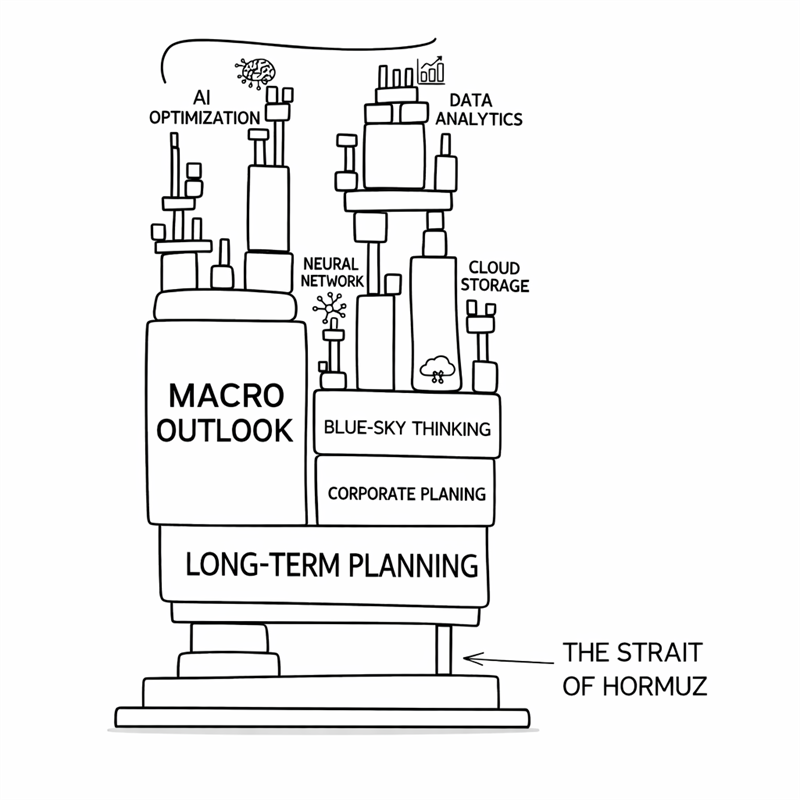
At times, it has felt like much of the global economy can be summed up by the image below - resting on a single pressure point. The Strait of Hormuz, a key route for global energy supply, has become central to how markets are framing risk. That alone has been enough to shift sentiment meaningfully.
Against that backdrop, markets have moved, but in a way that is not unusual given the shift in sentiment. While there were pockets of strength earlier in the year, particularly in Canada, much of that relative outperformance has since been given back. That earlier strength was driven largely by precious metals (gold and silver), which have since pulled back, bringing Canadian markets back in line with weakness seen globally. As a result, most major indices are now modestly negative or near flat as we approach month end. Since the onset of the conflict, the pullback has been more pronounced, with the U.S. stock market down approximately 4.76%, the Canadian stock market down 7.53%, and the Canadian aggregate bond market down 2.55% from February 28, reflecting the speed of the shift in sentiment.
.png)
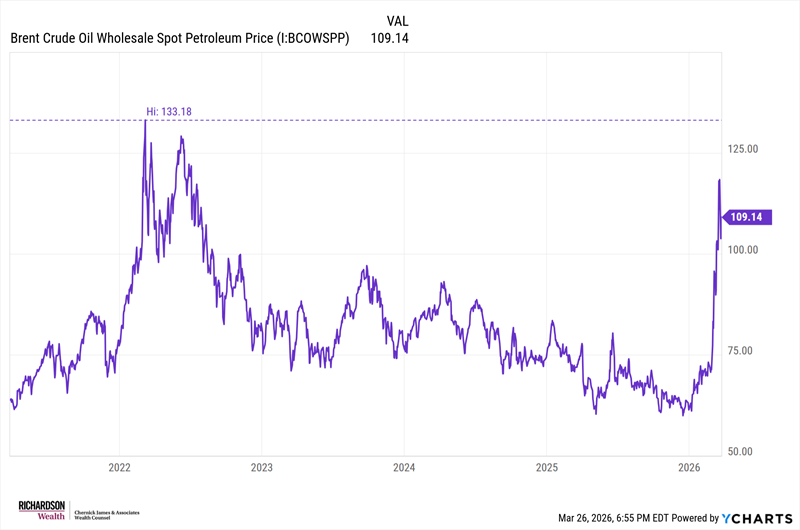
The main driver of market volatility has, of course, been oil. Markets have spent the past several weeks trying to assess the risk of supply disruptions, with prices moving sharply in response to each new headline. We have seen oil move above $109 per barrel, still below the highs reached during the Russia-Ukraine conflict, before pulling back quickly on signs of potential de-escalation, only to yo-yo back higher again as tensions shift. This is not a market lacking direction, but one lacking confidence in any single outcome.
That uncertainty is also beginning to influence expectations around central bank policy. Earlier in the year, markets were positioned for rate cuts. More recently, higher oil prices, and the possibility they remain elevated, have shifted the conversation toward inflation risks and even potential rate hikes. We view that outcome as unlikely and overly punitive, given it would be a response to supply-driven pressures rather than underlying demand, but the shift in expectations itself is adding another layer of pressure for markets to absorb.
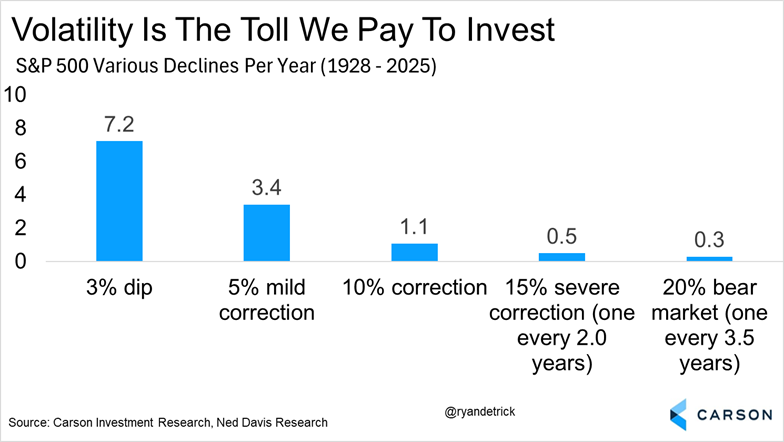
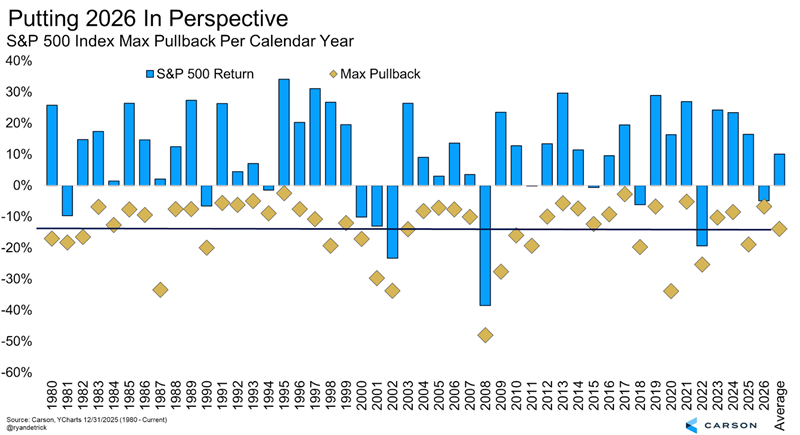
Stepping back, the broader pattern remains familiar. In a typical year, markets experience roughly three pullbacks of around 5%, along with the occasional larger move closer to 10%. Volatility is not an anomaly - it is the price of admission for investing. What feels exceptional in the moment is often well within the range of normal market behavior when viewed over a longer period.
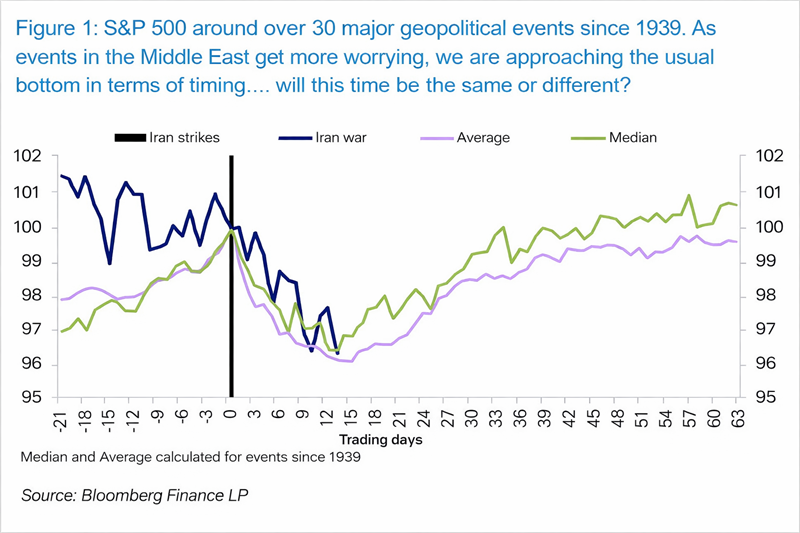
We have seen this playbook unfold many times during geopolitical events. As the chart below illustrates, markets tend to react quickly as uncertainty rises, but also stabilize and recover before there is full clarity. While each situation is unique and timelines are never one-for-one, the broader pattern has been consistent. That reflects the forward-looking nature of markets, where prices adjust rapidly to new risks, but just as quickly begin to anticipate their resolution. Importantly, some of the strongest days in markets often occur during these periods, not after they have passed.
This ties into a key point we continue to emphasize. A meaningful portion of long-term returns comes from a relatively small number of trading days, and those days often occur when conditions feel the most uncertain. Missing them can have a lasting impact, which is why maintaining a disciplined, long-term approach remains critical. At the same time, while the narrative has shifted quickly, the underlying fundamentals have been far more stable. As the charts below show, earnings expectations continue to move higher and margins remain near cycle highs. In many cases, the narrative has simply moved faster than the data.
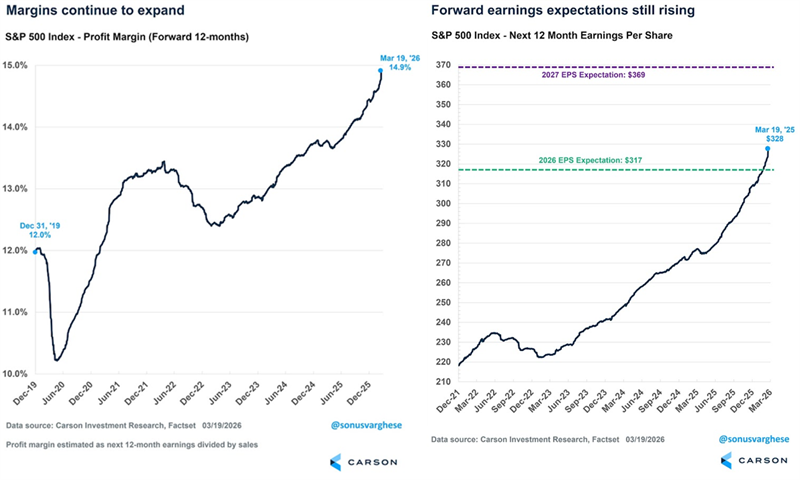
From our perspective, this is a period where short-term uncertainty is elevated, but it is unfolding against a backdrop that remains fundamentally sound. There are real risks to consider, particularly around energy markets and potential supply disruptions, but markets are actively working through those risks in real time. That process is not always smooth, and it is what’s driving much of the volatility we are seeing.
Our role in environments like this is to stay adaptive without becoming reactive. We continue to reassess how these developments may impact the businesses we own, where risks may be shifting, and where opportunities may be emerging. While the direct impact on underlying fundamentals has so far been limited, we remain mindful that conditions can change and are prepared to adjust as needed. Our focus remains on positioning portfolios to navigate both the uncertainty in front of us and the opportunities that tend to follow.
We will continue to monitor developments closely and keep you informed as the situation evolves.
- Jack
Perspective in a Noisy Market: Larry Fink’s Annual Chairman’s Letter to Investors
Each year, Larry Fink, CEO of BlackRock, publishes his annual letter to investors. It’s consistently one of the more thoughtful pieces in our industry - and this year is no exception. I went through this year’s edition while away last week, and it stood out as a thoughtful zoom-out on the bigger forces shaping markets and the global economy. Particularly useful in a month like the one we’ve just experienced, with war-driven volatility reminding us how quickly sentiment can shift.
His framing is simple but important. What once would have defined an entire decade now feels routine: wars with global implications, trillion-dollar companies, a reshaping of global trade, and the rise of transformative technologies like AI. The challenge is how we process it.
As Fink points out, markets today filter everything through a short-term lens. Daily moves get treated as meaningful signals, complex shifts get compressed into headlines, and reactions are often immediate. It can feel almost dopamine-driven. But speed can distort perspective, and it tends to crowd out long-term thinking. That doesn’t mean short-term activity is useless - it plays a role in pricing risk and allocating capital. But over time, staying invested matters far more than trying to time it - a mantra that sits at the core of our team’s investment philosophy.
One stat he highlights is a powerful reminder. Since 1989, a dollar invested in the S&P 500 has grown more than 15 times the value of a dollar tied to median wages. And importantly, when it comes to market participation, missing just the ten best days cuts that outcome by more than half. Many of those “best days” came during periods that felt the most uncertain. That’s exactly the type of environment we find ourselves in from time to time - and arguably again at this moment.
Another point he raises, which I think is underappreciated, is where wealth creation has actually occurred. Over the past few decades, it has overwhelmingly accrued to asset owners, not wage earners. And with AI, that dynamic has the potential to accelerate, particularly through the companies building the infrastructure that underpins it - data centres, semiconductors, and the broader ecosystem required to scale these technologies.
This gets to the root of a lot of the economic anxiety we’re seeing today. Not that the system isn’t working, but that it doesn’t feel like it’s working for enough people. His conclusion is one that aligns closely with our own investment approach. The answer isn’t more short-term thinking. It’s broader participation in long-term investing. That’s how individuals build wealth, and how countries build durable economic strength.
For those interested, I’d strongly recommend giving the full letter a read. It’s one of the better big-picture pieces I’ve come across this year and a useful reminder to stay focused on what actually matters.
Read the full 2026 Chairman’s Letter.
Staying Safe Online: Protecting Your Client Portal Access

We’ve seen an increase in online impersonation and fraud attempts across the industry. While this isn’t something we’ve experienced directly within our client portal, it’s a good reminder to stay vigilant when accessing your accounts online.
One of the simplest and most effective ways to protect yourself is by enabling multi-factor authentication (MFA). This adds a second layer of security when logging in - typically a code sent to your phone - making it much harder for unauthorized users to access your account.
A few additional best practices:
- Always access your accounts through trusted links or saved bookmarks
- Be cautious of any unexpected emails, texts, or calls asking for login details
- If something doesn’t feel right, it’s worth double-checking
Protecting your information is a shared responsibility, and small steps like these go a long way.
AI in Medicine: A Small Story With Big Implications
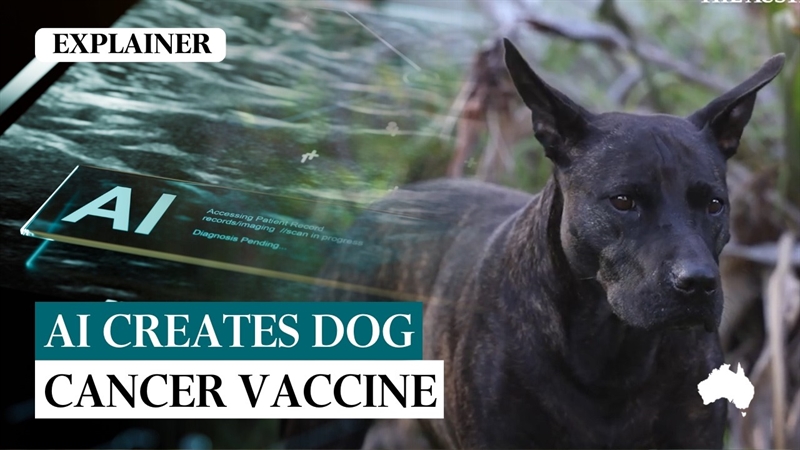
We often hear that AI will transform healthcare, but it’s not always clear what that actually looks like. A recent story brings it to life. After being told his dog had terminal cancer, an Australian tech entrepreneur used AI tools like ChatGPT to explore alternatives and, working with scientists, helped create a treatment tailored specifically to his dog’s cancer. It wasn’t a cure, but the results were meaningful, with tumors shrinking and quality of life improving. What stands out isn’t just the outcome, but how quickly they were able to move from problem to potential solution. It’s a small, early example, but a powerful one that gives a glimpse into where this technology could be heading.
Play Video