The Uncertainty Discount
Jack James - Mar 04, 2026
- Estate Planning
- Investment Services
- Portfolio Management
- Special Reports and Newsletters
- Wealth Management
With February wrapped, the month largely lived up to its reputation as one of the year’s seasonally weaker stretches. As we flagged in our early February note, the market’s tone had begun to shift away from early momentum toward a period of digestion. The month ultimately played out as a steady grind of choppy trading, driven more by rotating narratives than by any broad change in fundamentals.
.png)
At a glance, you might look at the chart above and think markets do not appear especially unsettled - and at a high level, that would be fair. Canadian equities have quietly put together another strong start to the year, supported by strength in energy and precious metals. Meanwhile, U.S. markets have been flatter, with modest weakness concentrated in more technology-heavy areas. Nothing severe. Nothing disorderly. But enough movement beneath the surface to warrant a closer look. It is that beneath-the-surface activity that has really defined February.
Over the course of the month, volatility picked up across parts of the technology complex, particularly within software, where a growing debate has emerged around how artificial intelligence may reshape established business models. The weakness in this group has been driven less by weakening fundamentals and more by investors reassessing how durable certain high-margin models may prove to be as AI tools become more capable and more deeply embedded into everyday workflows. When long-standing advantages are questioned, even in theory, markets tend to respond quickly.
That repricing in software has created a gravitational pull on U.S. markets more broadly. When a sector that has been a prominent market leader for several years cools - even temporarily - it naturally influences surrounding areas and overall sentiment. That dynamic helps explain much of the relative moderation in U.S. performance you see in the chart so far this year.
As our readers know, this is not an entirely new conversation. Concerns about the pace and scale of AI-related investment have circulated for months - the worry that spending could outrun returns, echoing past periods of technological exuberance. What earnings season has continued to show, however, is that investment is being met with real and growing demand. The businesses driving that buildout are reporting the kind of results one would expect if the opportunity were tangible - revenues expanding, margins remaining healthy, and forward outlooks that remain constructive. At times, the narrative has simply been louder than the numbers.
Stepping back, this month’s reaction in the software sector is likely just the earliest expression of a much broader shift. AI’s influence - and the questions around how it may disrupt existing models - is unlikely to remain neatly confined to one sector. Its impact is already extending into how businesses across the broader economy operate, compete, and create value. Assessing that evolution - understanding how each business we own is adapting, where AI could accelerate change, and how quickly that could unfold - has been a consistent part of our process in recent years as the pace of change has accelerated. It is what allows us to approach this period thoughtfully rather than reactively, and with perspective.
Viewed through that lens, February looks more like consolidation than anything more structural. Periods of pause after strong advances are normal, and the uncertainty we are seeing today tends to settle as more information comes into focus. Our focus remains on what we know - owning businesses with improving fundamentals, durable competitive positions, and meaningful participation in the structural growth shaping the global economy. That has not changed, and neither has our confidence in how we are positioned.
As the year progresses, the AI story will continue to broaden, extending its influence well beyond technology. Staying ahead of that evolution has been a central focus of our team’s work for some time. It is a theme we have been actively preparing for, and that preparation informs how we are positioned today. The foundations remain solid, and our confidence in the path ahead is steady. We will continue to bring you into the story as it unfolds.
- Jack
A Brief Note on Middle East Developments
Since finalizing our market update on Friday, events over the weekend involving U.S. and Israeli strikes on Iran, and broader Middle East fallout, have added a new layer of uncertainty worth addressing
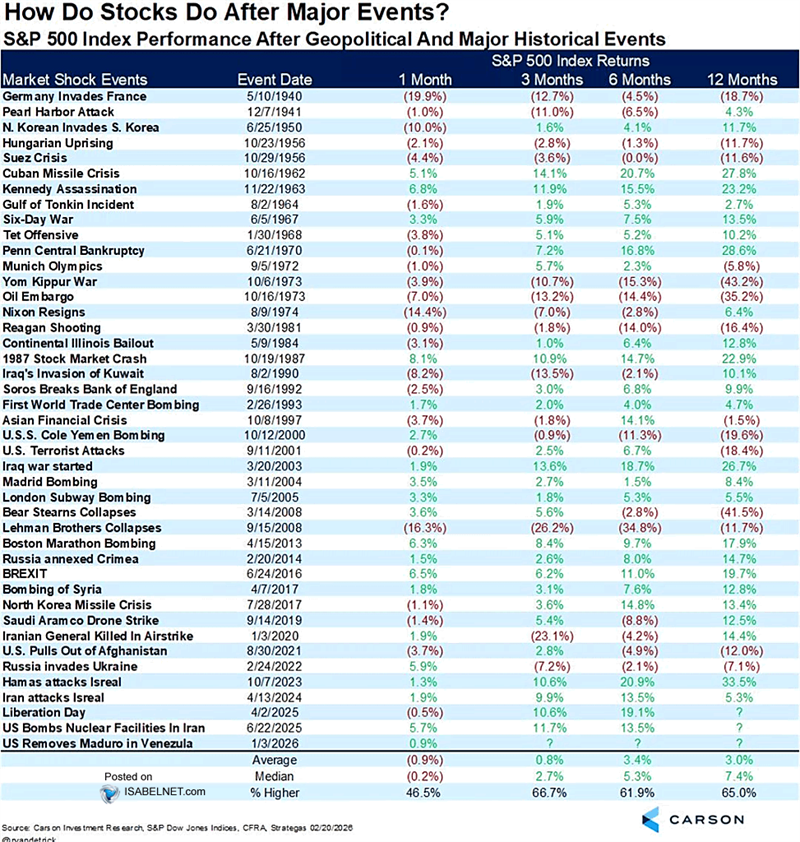
We have seen this pattern before. Geopolitical shocks tend to prompt an immediate market reaction, but over time markets adjust as clarity improves. The charts below, courtesy of Ryan Detrick at Carson Investment Research, help put that into context. Following major geopolitical events since World War II, the S&P 500 has delivered a median gain of 5% six months later, despite often being unsettled in the early days:
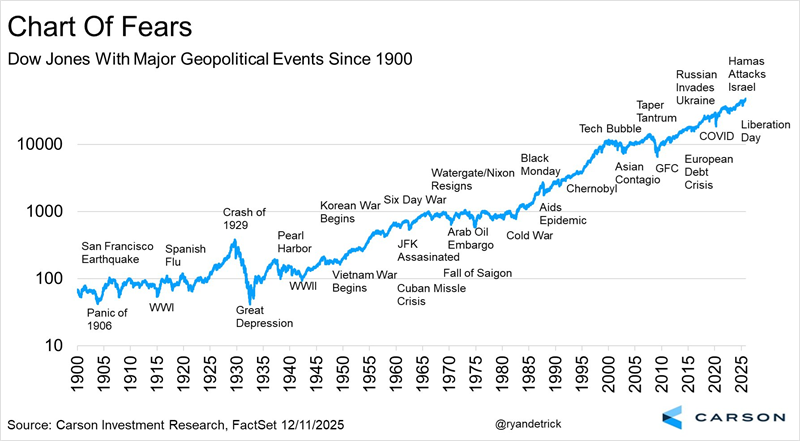
Zooming out even further, over more than a century of wars and global crises, markets have continued to advance despite periods of short-term turbulence. The overall message is one we will continue to reinforce, no matter what is thrown at us: staying invested pays off.
None of this diminishes the seriousness of what is unfolding. It simply provides perspective at a moment when headlines can feel overwhelming. Our approach remains unchanged. We continue to focus on fundamentals, manage risk thoughtfully, and stay grounded in the long-term discipline that has guided us through prior periods of uncertainty.
Trusts and Estates in the Age of Artificial Intelligence
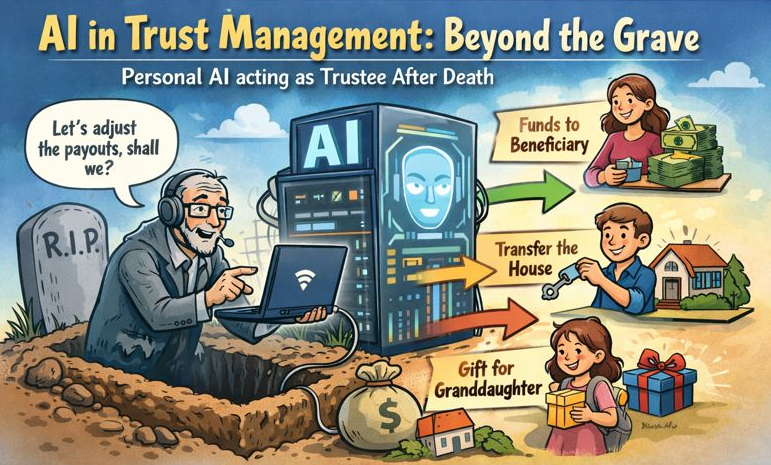
I recently spent two days at the Estates, Trusts & Pensions Journal Conference, where part of the discussion centered on how artificial intelligence is beginning to intersect with trusts and estates in practical, measurable ways.
What resonated most with me was how technology can improve process. Estate administration often involves locating digital assets, organizing years of records, tracking deadlines, and maintaining clear communication with beneficiaries. AI tools can assist with compiling asset inventories, organizing documentation, and creating reliable audit trails. In an area of law that relies heavily on accuracy and timing, these tools have the potential to reduce delays, limit administrative errors, and ease the burden placed on families during an already challenging period.
The conversation was not about changing the legal framework, but about refining how certain functions are carried out. Smart contracts can automate clearly defined, mechanical tasks such as distributions tied to objective conditions or scheduled payments. DAOs can offer structured coordination when there are many decision-makers, providing transparent voting processes and documented outcomes.
One particularly interesting discussion explored donatio mortis causa, or deathbed gifts. These gifts have historically been vulnerable to evidentiary disputes because they are often made verbally and in urgent circumstances. Emerging technologies may help create secure, time stamped records of intention and conditional transfers, particularly for digital assets. Clearer documentation can reduce uncertainty and provide stronger support if questions arise later.
My overall takeaway was practical and forward looking. As estates become more digital and asset structures more complex, thoughtfully integrating technology into planning and administration may enhance efficiency and organization. Used carefully, these tools can strengthen estate management and help ensure that intentions are carried out with greater consistency.
- Alysha
BC Property Tax Deferral Changes - What Homeowners Should Know

The BC government has made changes to the property tax deferral program. If you’ve used this strategy in the past, or are considering it, here is what matters.
Existing deferrals remain under the old rules: If you deferred property taxes under the old program, your accumulated balance continues at the old, lower interest rate and uses simple interest calculations. This rate is set twice a year and is typically less than the Prime Rate. As of February 20th, this rate is 2.95%.
New deferrals beginning in 2026 will be different: New deferrals will be charged at a higher interest rate - currently the Prime Rate plus 2%, which is 6.45% as of February 20th (subject to change). Interest is calculated monthly, and is a compound interest calculation, meaning that you will pay interest on your interest over time.
A few common questions:
Q: I deferred taxes under the old system. Will my interest rate change?
A: No. Past deferrals are locked in at their original interest rates and calculated using simple interest.
Q: If I stop deferring in 2026, do I owe all deferred amounts at once?
A: No. You’ll simply resume paying your annual property taxes going forward. The deferred balance remains until you sell or transfer the home.
Q: What’s the new interest rate for future deferrals?
A: As of today, future deferrals are at prime plus 2% (currently 6.45%) and will compound monthly.
Q: How will compound interest affect my future deferred balance?
A: Unlike simple interest, compound interest means you’ll pay interest on the interest, which can increase the total amount owed over time.
Q: Can I choose not to defer anymore?
A: Yes. You can stop deferring anytime. You’ll pay your regular annual taxes, and any previously deferred balance will continue to accrue interest until the home is sold.
Everyone’s circumstances are unique, but generally speaking, this rate of interest makes the program far less attractive.
If this impacts your planning, we are happy to walk through the numbers with you and assess whether continuing to defer still makes sense.