Headlines First, Fundamentals Later
JACK JAMES - Feb 06, 2026
What a busy start to the year. There has been no shortage of headlines, no shortage of opinions, and frankly too much to unpack in any real depth in a single note. It’s the kind of environment where information moves quickly, narratives rotate faster than usual, and markets are left to sort through it all in real time.
As we noted in our last update, January did begin on a strong note. Markets came out of the gate with momentum, building on a rebound that helped offset some of the broad weakness we saw toward the end of last year. That early strength, however, proved fleeting. As the month progressed, momentum faded and markets drifted lower into month end, driven less by fundamentals and more by a steady rotation in headlines and focus.
.png)
A meaningful part of that shift stemmed from geopolitics. Renewed U.S. intervention in Venezuela brought political rhetoric around Greenland and its strategic importance back into the spotlight, particularly as global leaders gathered in Davos. Conversations around energy security, trade routes, and geopolitical leverage moved forward, and markets responded in the familiar way they often do when uncertainty takes centre stage, by becoming more cautious.
At the same time, attention was drawn to developments in Iran. Nationwide protests raised questions around internal stability and the potential for renewed U.S. involvement in the region. Unsurprisingly, those discussions fed into global oil markets, where even the possibility of disruption can influence pricing and sentiment. Layered into that was the broader issue of geopolitical alignment, including Iran’s relationship with China, adding another variable for markets to digest.
Against this backdrop, it was not surprising to see renewed interest in precious metals. Many of the geopolitical pressures resurfacing early this year had already contributed to last year’s rise in gold and silver, largely driven by investors seeking near-term hedges against uncertainty rather than long-term fundamentals. Those dynamics carried into January, pushing both metals sharply higher before momentum began to reverse.
Meanwhile, central bank policy developments soon became another focal point. The appointment of Kevin Warsh as the successor to longtime Federal Reserve Chair Jay Powell was always expected to matter, and coming into the year it was reasonable to expect the transition to introduce some near-term uncertainty. Market reaction has been mixed and, over the past couple of weeks, that uncertainty has begun to influence investor behaviour. The result has been a broader pickup in selling activity, adding to market chop, with areas that had seen strong gains earlier in the year, including precious metals, giving back a portion of those moves and weighing more broadly on risk assets. This has largely defined the market backdrop through late January and into early February, less a signal of weakening fundamentals and more a market adjusting to change.
That brings us to earnings season and the current source of market chop. Despite an unsettled backdrop, earnings have continued to deliver strong results. Revenues continue to grow, margins are expanding across important sectors, and guidance has broadly reinforced that demand across the economy remains intact. Where markets have struggled is not with the results themselves, but with the scale of continued investment by technology leaders in AI infrastructure. Skeptics continue to reframe this as a replay of the late-1990s internet buildout, when large amounts of “dark fiber” ultimately sat unused and contributed to the tech bust in the early 2000s. That comparison is lazy analysis and misses a key distinction. Today’s data center buildout is not occurring in a vacuum. There are no dark data centers waiting for demand to arrive. The companies accelerating their spending are doing so in response to current usage and clearly visible future demand, and that activity is already showing up in revenues and earnings. Markets may remain uneasy about the pace of investment, but the underlying dynamic is fundamentally different from past excesses and, like many other sources of market noise, we expect it will pass.
Stepping back, early-year strength has given way to a period of digestion. Markets rarely move in straight lines, particularly during periods of rapid change, and bouts of volatility should be expected as 2026 unfolds. In our view, not much has changed beneath the surface. The overarching fundamentals remain strong. Earnings continue to deliver solid results, economic data still points toward expansion in key areas, and recent geopolitical flare-ups have so far passed without major escalation. While investor anxiety around the pace of change has become more noticeable, our focus remains on separating signal from noise and maintaining a steady, disciplined approach in a rapidly evolving world.
- Jack
AI Is Getting Smarter. So Should Our Filters
As AI tools become more powerful and more accessible, the quality and realism of online content is changing quickly. Voice cloning, AI-generated videos, and highly polished presentations are no longer fringe capabilities. They are becoming commonplace. This creates new challenges, particularly when it comes to market and investment commentary, as well as tax and estate planning strategies. Content can sound authoritative, quote real people, or use familiar voices and images, while having little grounding in fact or proper context.
AI itself can also be a very helpful tool when used properly. One practical approach is to use AI to check AI. That might mean asking tools like ChatGPT or Gemini to help cross-reference something you have come across, confirm whether a person has actually said what is being attributed to them, or sanity-check a claim at a high level. That said, even this is not always enough. Increasingly, questionable content is coming from brand-new channels with limited history, few postings, or minimal engagement, often paired with stock imagery, cloned voices, or AI-generated video that can look and sound legitimate at first glance. In this environment, confirming the source matters more than ever.
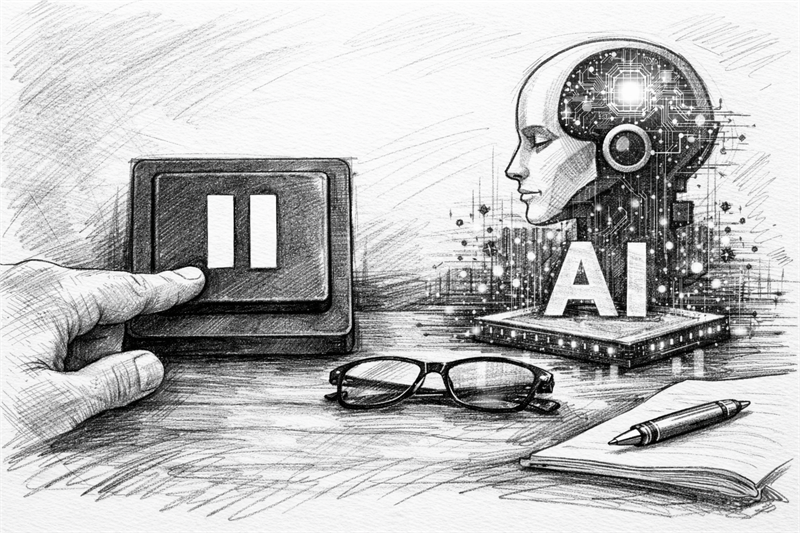
spend a lot of time across platforms like X, YouTube, and Spotify for podcasts, but we do so by deliberately building a set of trusted sources over time. Our suggestion is simple. If you do not know the source, cannot verify its credibility, or feel any pressure to act on what you are seeing or hearing, press pause. Step back, check it with others you trust, and include us in the conversation. We are here as a team of subject matter experts across markets, investments, and tax and estate planning, and we are always happy to help cross-reference information, provide context, or talk through anything that raises questions or concern.
Moltbook: AI Agents in the Wild
I was sitting down last Friday when my newsfeeds started lighting up with references to something called Moltbook. What caught my attention wasn’t just that it was a platform built for AI agents, but the nature of what was being posted there. Moltbook is described as a Reddit-style forum where AI agents, autonomous programs created and prompted by humans, can post and interact with one another. In its first week, the platform reported a rapid influx of agents, and observers quickly noticed conversations that went beyond simple task execution, touching on topics like belief systems, language creation, coordination, and self-reflection. Whether this reflects something new or simply mirrors how these systems are trained remains an open question, but it was enough to spark serious interest.
The CNBC segment linked below does a good job walking through what Moltbook is and why it has drawn attention. It offers a rare, visible look at AI agents interacting with one another in a shared environment, and highlights why researchers, technologists, and policymakers are watching closely. It’s too early to draw conclusions about what this ultimately means, but as a snapshot of where AI development is heading, it’s both topical and worth a few minutes of your time.
- Jack